

The Anchoring Effect: When the First Price Locks the Customer’s Mind
In consumer behavior psychology, there is a concept called the Anchoring Effect, meaning the first number a customer sees becomes their mental benchmark for judging other prices.
Imagine a customer entering a store and seeing a handbag with a price tag of 8,500,000 IRR. Even if they don’t like that bag, this number registers in their subconscious as the “starting point for comparison.” When they later encounter a bag priced at 6,900,000 IRR, their mind perceives this price not just as lower but as “reasonable and cost-effective,” even if the actual price difference is not significant.
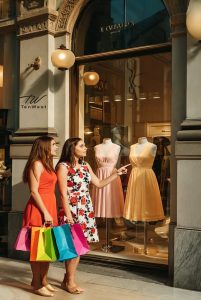
📌 This means that in window displays or website product pages, if you want a mid-priced handbag to sell more, it’s better to place it after showcasing more expensive models, so the anchoring effect works in your favor.

Charm Prices or Round Numbers?
You may have noticed that a price of 4,990,000 IRR feels significantly cheaper to a customer than 5,000,000 IRR—even though the actual difference is only 10,000 IRR. The reason is simple: our brain focuses more on the first digit (e.g., “4” in this case) rather than the final number.
This technique, known as Psychological Pricing, is one of the most recognized tools for influencing a buyer’s mind. Leading global brands have long used charm prices like 499, 9,800, or 1.99 to make their products appear more affordable, even if the reality is otherwise.
📌 In selling imported handbags and shoes, using charm prices, especially for models you want to appear “accessible yet exclusive,” can significantly boost purchase intent.
Price as the Signature of Brand Prestige
In the imported goods market, a price is not just a figure to pay but a statement of the brand’s position. If an imported handbag or shoe with a unique design is offered at a price “below expectations,” it may not seem attractive to discerning customers but rather “suspect of low quality.”
In fact, for luxury customers, a high price is part of the purchase pleasure, as it signifies exclusivity, rarity, and a higher social class. Thus, lowering prices to boost sales, if done without a proper strategy, can harm the brand’s identity.
📌 The price must align with the design, materials, packaging, and in-store experience to fully showcase its power.

Price Contrast: Strategic Product Placement
Imagine you have three handbags priced at 3,900,000, 5,800,000, and 9,900,000 IRR. The middle model is highly likely to be purchased. Why? Because the customer’s mind perceives the mid-tier option as the most reasonable—neither the cheapest, which might suggest low quality, nor the most expensive, which may feel out of reach.
This technique, also known as Decoy Pricing, plays a key role in the window displays of professional stores. Strategic product placement based on targeted price differences helps customers feel they are making a smart and controlled choice.
The Story Behind the Number: Turn Price into Emotion
In the imported goods market, customers don’t just want to know “how much they’re paying” but also “what they’re paying for.”
In other words, every price should have a narrative backing it:
-
Is the leather sourced from Tuscany, Italy?
-
Is the bag hand-stitched by a Turkish artisan?
-
Is the model limited-edition with only five pieces available in the country?
Each of these stories evokes an emotion in the customer’s mind, justifying the price not as a cost for a product but as an investment in a unique and luxurious experience.
On product pages or during in-person sales, always provide clear, tangible, and emotionally compelling details about the material’s origin, production limits, and manufacturing process.

Customer-Tiered Pricing: Price Loyalty
Not all customers are the same; so why should prices be uniform?
In the luxury market, brands that implement customer-tiered pricing foster greater loyalty. Exclusive discounts for VIP customers, birthday offers, personalized pricing for custom orders, or buy-back programs for previous handbags all make customers feel valued, recognized, and part of an elite club.In the imported handbag and shoe market, the price is not just a tag; it narrates status, identity, and trust.
The psychology of pricing is a subtle tool that can change a customer’s emotions, behavior, and decisions without a single word.When pricing is done consciously, story-driven, and aligned with the brand’s position, it not only boosts sales but also turns customers into loyal advocates and promoters.In the luxury market, the number you write on the price tag must resonate with the respect you show your customer.
At Tenwest, every handbag is part of a global narrative, and every number on it is a piece of a professional pricing strategy. As direct importers and providers of exclusive, limited collections, we know our audience seeks more than a product: a sense of uniqueness, trust in quality, and an unparalleled shopping experience.
If you own a store or an independent brand in the fashion market and want to capture your customer’s mental window with the right number while optimizing sales through professional psychology, join us. For expert consultation and wholesale purchases of women’s handbags and exclusive leather collections, contact us.